
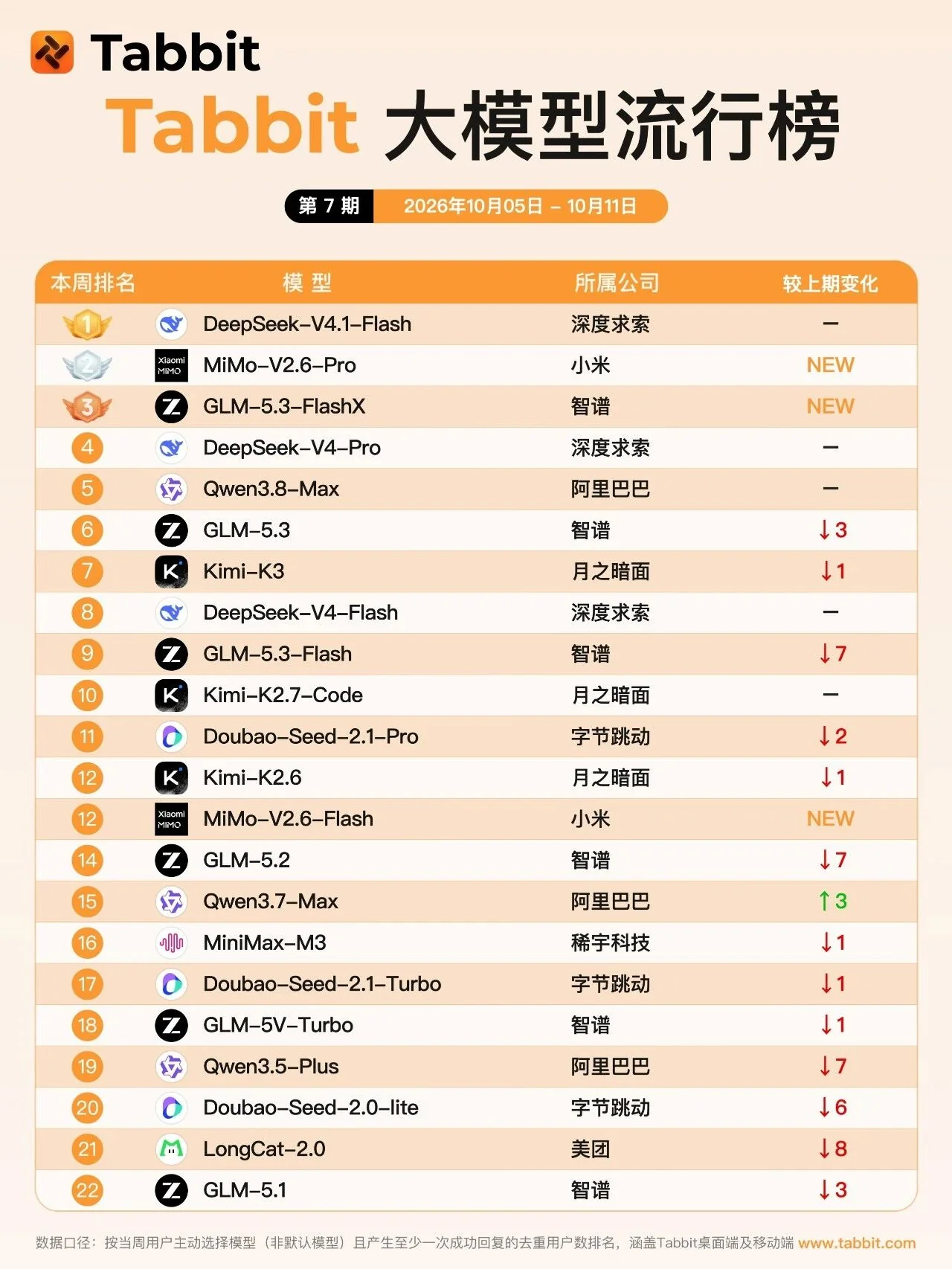
Issue 7 of the Tabbit Model Popularity Ranking covers October 5–11, 2026. Compared with issue 6, this ranking includes the first appearance of Xiaomi's MiMo models.
Xiaomi MiMo debuts, with Pro taking No. 2
Xiaomi's MiMo models make their first appearance in the Tabbit ranking. According to Xiaomi, MiMo-V2.6 marks a milestone in recursive self-improvement (RSI): the team scaled reinforcement-learning compute and ran days of continuous public training on complex, verifiable tasks, allowing the model to improve through feedback and trial and error in real environments.
The MiMo-V2.6 series offers several options:
MiMo-V2.6-Pro is Xiaomi's most powerful multimodal flagship to date. It supports joint text, image, video, and audio input and a 1M context window, targeting complex projects, long-running tasks, multi-agent collaboration, high-value work, cybersecurity, and scientific research. Its overall intelligence places it among the leading open-source and Chinese models in major evaluations. It debuts at No. 2 in this ranking.
MiMo-V2.6-Flash is an efficient reasoning model with native multimodal input and a 1M context window. It balances intelligence, efficiency, and cost for frequent workplace use and large-scale tasks, placing No. 12 this issue.
Xiaomi's MiMo-V2.6 series further expands Tabbit's model selection.
Zhipu's faster model joins, while the leading group stays stable
Zhipu's new faster GLM-5.3-FlashX also joins Tabbit, taking No. 3. DeepSeek-V4.1-Flash stays in first place, DeepSeek-V4-Pro ranks fourth, and Alibaba's Qwen3.8-Max is fifth. The leading group remains broadly stable, while new models continue to address a wider range of user needs.
That concludes last week's model popularity trends. If you have not tried Tabbit, download the desktop app free at www.tabbit.com.
Search for Tabbit in your app store to try the mobile app. Sign in to the same account to sync Campus Skills and data through the cloud.