
Tired of seeing every model provider publish another set of benchmark scores?
Noticed that every company claims its newest model is the best?
Still not sure what those benchmarks are actually measuring?
Would you rather know which models people genuinely use every day?
Giving people immediate access to the newest and broadest selection of models has been part of Tabbit from day one.
Internally, we have also built a comprehensive benchmark system for both chat and agent tasks.
But one question keeps coming up: does a higher benchmark score necessarily reflect what users prefer?
Is there a more direct way to see how popular a model really is?
Today, Tabbit offers more than 20 models, used every day by a large community for real work: coding, writing, research, office documents, translation, and everyday problem-solving.
These are not test questions designed for an evaluation. They are the varied needs that naturally arise in people's work and daily lives.
So what if we set aside every artificially designed test and use the simplest possible measure: how many people actively chose a model?
We do not write test questions for the models, decide which capabilities matter most, or cherry-pick samples after seeing the results.
Tabbit's user base is large enough to smooth out individual habits and one-off behavior.
The breadth of questions Tabbit users ask also keeps any single use case from skewing the ranking.
No custom test, no weighting, no cherry-picking. Every model follows the same rules, and real user choice determines the ranking.
That is why, starting this week, we are launching the Tabbit Model Popularity Ranking.
The ranking tracks one metric only: the number of unique users who actively selected a model in Tabbit during the previous week and completed at least one conversation with it.
Default-model usage is excluded. A model counts only when someone deliberately chooses it.
Our goal is to show which models Tabbit users are actually choosing and using right now.
Here is the first Tabbit Model Popularity Ranking, covering August 10–16, 2026.
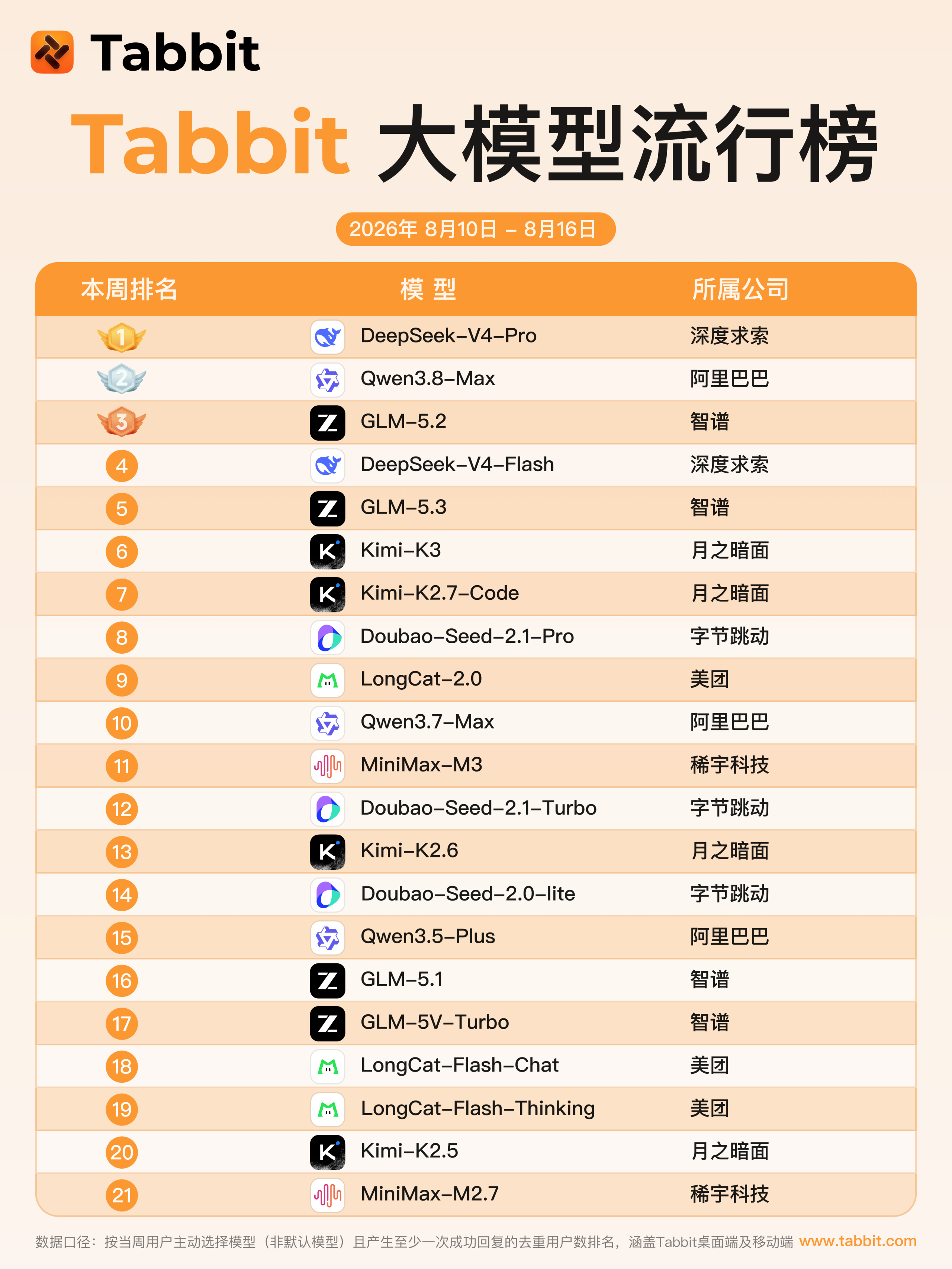
We will update the ranking every week to show which models people are genuinely using and how those preferences change over time.
We will also keep improving the ranking and explore more objective, useful ways to evaluate models.
If there are other dimensions or analyses you would like to see, let us know.
Of course, this ranking measures popularity within Tabbit. It is not an absolute verdict on model capability.
Tabbit's audience and use cases have their own biases, so this ranking should never be treated as the one definitive measure of model quality.
Different models suit different tasks and preferences, and people often switch models depending on what they need to accomplish.
We are not trying to start another model war. We want a ranking that takes the user's side—transparent, grounded in real choices, and impossible to game by training for a fixed test.
Putting model choice back in users' hands is exactly why Tabbit supports multiple models.
If you have not tried Tabbit yet, visit www.tabbit.ai to download it for free.