
Many people go through a similar stage when using AI tools.
At first, it feels dazzling. Toss it a question and it immediately gives a decent answer. Ask about industry trends, and it can explain them; ask it to organize meeting notes, and it can do that too. Send it an article, a report, or a webpage, and it gives feedback within seconds. In that moment, it feels as if the ceiling for productivity tools has suddenly been raised.
But after using it for a while, the excitement often cools down.
Because you discover that AI can indeed do a bit of everything, but it is hard for it to keep doing the same kind of work well and reliably for you. Today you ask it to analyze a company's financial report and the result is good. Tomorrow you switch to another report and its structure changes, its focus scatters. The day after that, you ask again and it changes its wording again. You have to keep adding context, rewriting requirements, and calibrating formats. Every conversation feels like starting from zero, with too much effort spent on setup.
This is a real dilemma for many people: even when AI participates in office work, it still does not truly become part of their working capability.
It also exposes a key problem in AI-assisted work: what we lack is not a single answer, but a methodology that can be called repeatedly.
Truly valuable human-AI collaboration is not asking from scratch every time. It is capturing a process that worked once, so it can continue to work for you in the future. Teach it one thing, and it can gradually learn to help you handle a whole category of things.
This is the problem Tabbit Browser's Skill feature wants to solve.
Skills let you store commonly used questions and AI work instructions as fixed commands. When a similar scenario appears, you only need to type / in the chat box to call them.
Creating a Skill is essentially about doing three things: solidifying a thinking framework, standardizing a workflow, and building a reusable knowledge module.
Once you capture these three things, AI's role changes. It is no longer just a chat box passively waiting for instructions, but more like an assistant that already understands how you work. You do not need to explain from scratch every time, or keep adding and correcting what you want, what structure to use, which information matters most, and which angles must be covered. Those requirements are already written into the Skill prompt.
So a high-quality Skill is worth far more than a single answer.
It does not only solve one specific problem. It also preserves a solution pattern for you. Spend time today designing the method clearly, and starting tomorrow, that method can be called repeatedly. What you own is no longer just a result in one scenario, but a more stable production capability for similar tasks.
For individuals, this means turning scattered experience into systematic capability. Many people have accumulated a large amount of implicit judgment and operating standards at work, but usually have no chance to articulate them fully, write them down, or reproduce them reliably.
What Skills do is externalize those experiences that used to exist only in your head, turning them into rules that AI can execute collaboratively.
More importantly, Skills currently come in three functional forms for different kinds of problems:
1. Prompt Skills:
Many high-frequency tasks can be completed reliably through a clearly structured prompt template.
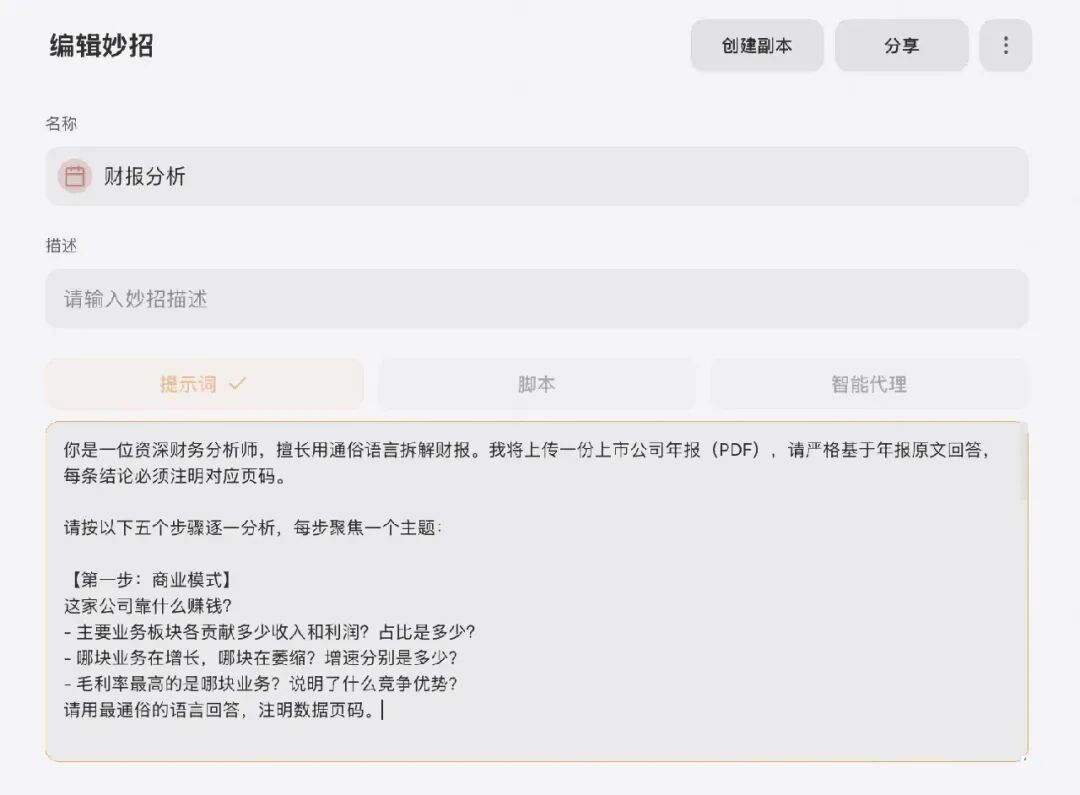
For example, in the investment research scenario mentioned earlier, reading company financial reports closely is essential, but it takes significant time and complex reasoning. If you already have considerable experience with this task, you can create a dedicated financial-report analysis Skill:
Input any report or set of reports, and have it automatically analyze business model, income statement, balance sheet, cash flow statement, management commentary, risk disclosures, and more. You can also constrain it with rules such as: analyze strictly based on the annual report text, do not cite information outside the report, do not use common sense to fill in undisclosed content, and provide page references for every conclusion. Use any rule you can think of to minimize AI guesswork and hallucination.
This way, you no longer need to rethink how to ask or how to specify the output format every time. You do not need to re-enter or copy and paste prompts, and you do not have to worry about missing a key angle. The analytical method and logical framework you have trained over years can be captured in a Skill, and can be adjusted whenever new experience is added.
2. Intelligent Agent Skills:
Still using finance as an example: tracking macro policies, industry updates, individual stocks, or company information every day may be essential for every practitioner. Every morning, you may need to open at least five or six fixed information platforms, check whether anything new happened today, read the latest reports and updates, and judge the value and hidden implications behind them. The whole process is time-consuming and mentally draining.
This kind of tedious, high-frequency task, cross-platform material collection and multi-source information synthesis, is exactly where Intelligent Agent Skills shine.
At this point, you can turn a fixed sequence of past actions, such as collecting, reading, and thinking, into a Skill:
Ask Tabbit to open the information sites you often use and collect information autonomously, such as Xueqiu, Wind, Bloomberg, the National Bureau of Statistics, the People's Bank of China, the Ministry of Finance, and other authoritative platforms.
Extract key points based on the analytical framework in your head, such as changes in the wording of policy information and what different pacing may sit behind them.
Output a summary report and judgment in the format and focus you want, such as citing sources and organizing important information into tables.
Then choose Intelligent Agent mode.
Every morning, you only need to open Tabbit and type / to call this Skill. It will automatically move across platforms and organize the material.
You can make yourself a cup of coffee while waiting for the result, or open other pages and do something else, because actions in Intelligent Agent mode do not affect other workspaces.
In Intelligent Agent mode, Tabbit is like an assistant you personally trained. It knows your work habits and priorities, can act independently across platforms, judge the urgency and importance of information, and distill the complex information world into the insight you truly need.
It is not just executing instructions; it is reproducing your way of thinking: your framework, your standards, and your logic of judgment.
3. Script Skills:
If Intelligent Agent is your information assistant, Script Skills are more like a magic wand hidden in your browser. Wave it, and the page changes.
Half of what it can do is fun, and half is useful.
The fun half satisfies your desire to control the web:
Tired of a site covered in ads? Clear them with one click. Want some fun during a boring meeting? Generate a retro Minesweeper game directly on the page, or create a desktop pet and interact with it.
These may sound like little programmer tricks, but with Skills, anyone can summon this kind of destructive joy at any time.
The useful half goes straight to the core of efficiency.
When you read a page mixed with plain text and data that looks messy and hard to grasp, or when you face a dense financial report where trends, comparisons, and anomalies are hidden among numbers, it is hard to form a clear structure immediately.
Script Skills can directly turn that data into visual charts: line charts, bar charts, pie charts. The structure of the information becomes clear and readable instantly. You no longer need to interpret it line by line; insights naturally emerge.
Prompts, Intelligent Agents, and Scripts look like three different capabilities, but behind them is the same idea: turn a method that worked once into a system that can be executed repeatedly.
Prompts reproduce your thinking framework. Intelligent Agents turn cross-platform repetitive actions into automated workflows. Script Skills turn "what you want to do to a page" into a reusable capability, whether the idea is wildly imaginative or seriously practical.
When you have 10 carefully designed Skills, what you really have is 10 validated problem-solving systems. They represent 10 ways of thinking, 10 workflows, and 10 stable output capabilities for common scenarios. When you face a new task, you no longer need to start by asking how to begin. You start by deciding which method and framework to call.
That may be the moment when AI truly begins to enter the workflow.
You define the goal, calibrate the standards, and keep optimizing the method. It follows those methods and continues to execute, organize, advance, and deliver. Humans provide judgment and direction; AI provides consistency and scale. This may be the more meaningful form of human-AI collaboration in practice.
Many tools are trying to make AI stronger, but Tabbit is thinking about whether AI can keep doing a category of things well, in my way, over the long term.
That is where the meaning of Skills lies.
They aim to formally preserve methods, make experience callable again and again, and move AI from scattered one-off answers toward a capability system that can truly accumulate, be reused, and collaborate.
So rather than saying Skills teach AI to complete a task, it may be more accurate to say that with Skills, you are building a new work asset for yourself.
Every Skill you set up with care is a gift to your future self.
P.S. If you have not tried Tabbit yet, click Read Original to enter the official website and download it for free.